
In West Java’s Sumedang Regency, a challenge once cast a long shadow over the future: stunting rates among children were higher than the national average. For a community of more than 1.2 million people, and as part of the growing Bandung Metropolitan Area, this meant more than a health issue. It threatened the promise of a generation that Indonesia needs in an era of demographic bonus, when the productive population outnumbers the dependent one.
Back in 2018, the figures were alarming. Nearly one in three children showed signs of stunted growth. The local government had tried several programs—nutrition-sensitive and nutrition-specific interventions—yet results fell short.
A deeper look revealed the core problem: unreliable data. Information on stunting cases was fragmented, sometimes inaccurate, and often difficult to access. Without solid data, interventions were misguided, resources wasted, and the long-term goal of raising a healthier generation remained distant.
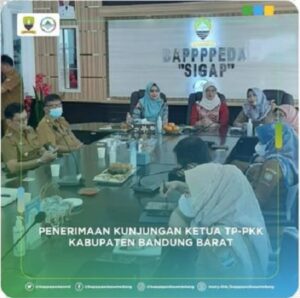
Recognizing this gap, the Local Development Planning Bureau of Sumedang Regency, known as BAPPPPEDA, set out to find a different path.
In 2020, it launched an innovation that combined technology with governance: the SIMPATI system, short for Sistem Informasi Pencegahan Stunting Terintegrasi (Integrated Stunting Prevention Information System).
SIMPATI was designed to capture real-time data on child nutrition and health, turning scattered information into a single, accessible source. With reliable data at hand, policies could be sharper, interventions more precise, and progress easier to track. What once felt like an uphill battle began to shift.
The results tell the story. Within three years, the stunting rate in Sumedang fell dramatically—from 32.27 percent in 2018 to just 8.27 percent in 2022. Behind these numbers are thousands of children with stronger chances to grow, learn, and thrive.
What began as a response to inadequate data management has become a model for how local governments can harness information systems to solve pressing social challenges. In Sumedang, innovation has not only improved statistics—it has opened doors to a healthier future for its youngest citizens
Sumedang Regency faces a significant public health challenge in the high prevalence of stunting among children. In 2018, nearly one in three children in the region exhibited stunted growth, a figure above the national average. This condition poses long-term risks to human capital development, as stunting affects cognitive and physical development, educational outcomes, and future productivity. The issue is particularly urgent given Indonesia’s demographic bonus, where a larger proportion of the population is of working age, emphasizing the need for a healthy younger generation. Efforts to address stunting are hindered by limitations in data collection and management. Information on toddlers’ health status, nutrition, and the coverage of interventions is fragmented, often outdated, and difficult to access. Many villages lack comprehensive records, and census activities for toddlers and pregnant women are irregular or incomplete. This creates significant gaps in understanding the scope of the problem, making it challenging to identify at-risk populations or evaluate the effectiveness of ongoing programs.
The lack of centralized, accurate, and real-time data further complicates coordination between stakeholders, including local government units, healthcare services, and community organizations. Without reliable information on child health and intervention coverage, policymaking and program implementation remain constrained, leaving children vulnerable and stunting rates persistently high.
SIMPATI (Sistem Informasi Pencegahan Stunting Terintegrasi) is an initiative developed to strengthen stunting reduction efforts through reliable, real-time information. Its objectives include providing accurate data on toddlers and intervention coverage, offering evidence for policymaking, measuring program effectiveness, and serving as a learning tool for continuous improvement. Aligned with the Sustainable Development Goals, particularly Goal 3 on good health and well-being, SIMPATI supports the promotion of healthier lives, with a focus on children.
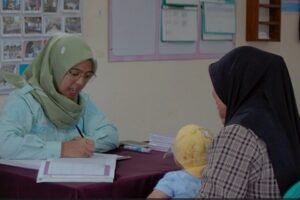
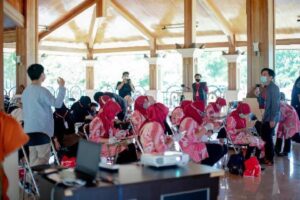
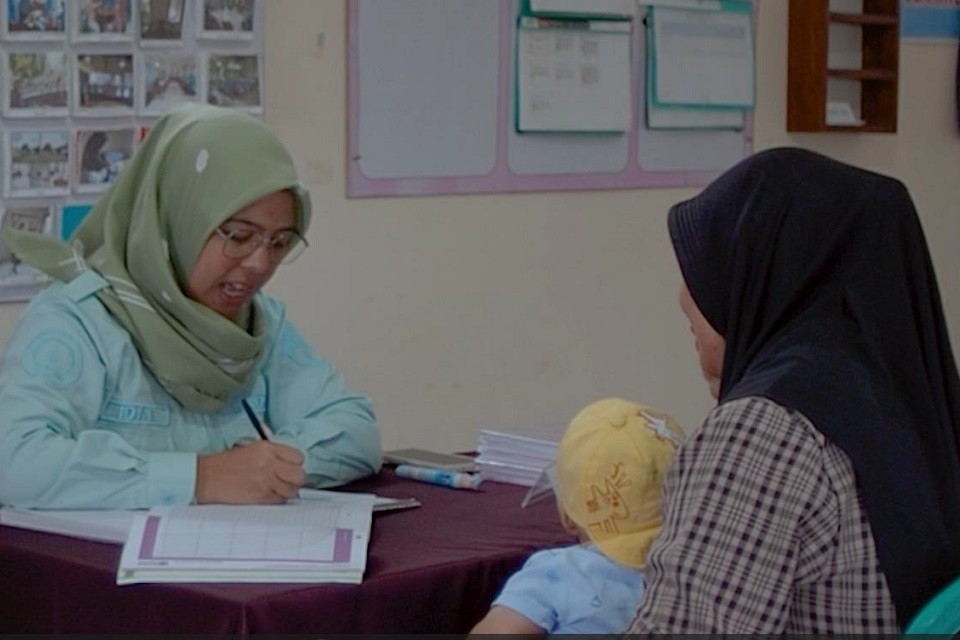
To achieve these aims, the Local Government of Sumedang Regency has implemented the SIMPATI application across all subdistricts by mobilizing community cadres as primary data collectors. More than 1,700 POSYANDU (Integrated Healthcare Services Post) and Human Development Cadres (KPM) have been engaged. These cadres, largely women from diverse backgrounds, work voluntarily to record data and interact with families. They are trained to use smartphones and digital applications to ensure timely and precise information entry.
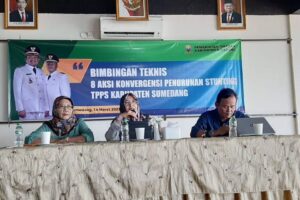
Through SIMPATI, children’s identities, growth indicators, and intervention coverage are directly input at the village level. Data are then consolidated by regional task forces, which also provide recommendations based on 35 essential service indicators.
The introduction of the SIMPATI application (Sistem Informasi Pencegahan Stunting Terintegrasi) represents a systematic approach to converging and integrating stunting reduction programs across multiple stakeholders using reliable, real-time data.
By applying the principle of Good Data, Good Decisions, Good Results, Sumedang Regency has established a data-driven ecosystem that strengthens policy formulation and intervention strategies from the village to the district level.
The impact of this initiative has been measurable and substantial. Stunting prevalence, which stood at 32.3 percent in 2018, declined sharply to 8.27 percent in 2022. Projections indicate that prevalence may stabilize around 9 percent by 2023, only four years after implementation.
This reduction demonstrates the effectiveness of SIMPATI in enhancing program accuracy, improving resource allocation, and ensuring that prevention measures reach targeted beneficiaries.
The program is grounded in a pentahelix collaboration model that mobilizes government, community, and private sector contributions. The local government, through BAPPPPEDA, ensures program management and alignment with development priorities. PT. Telkomsel provides technological support by equipping cadres with smartphones, SIM cards, and training. At the community level, POSYANDU cadres act as field enumerators, ensuring the collection and operation of real-time data.
SIMPATI’s structured business process also ensures replicability beyond Sumedang. Recognition at the national level has reinforced its relevance: the Regent of Sumedang has been invited to present the model at a National Coordination Meeting attended by the President of Indonesia, who endorsed replication in other regions.
In 2023, SIMPATI was further acknowledged through the Public Service Award from the Ministry of State Apparatus Utilization and Bureaucratic Reform.