
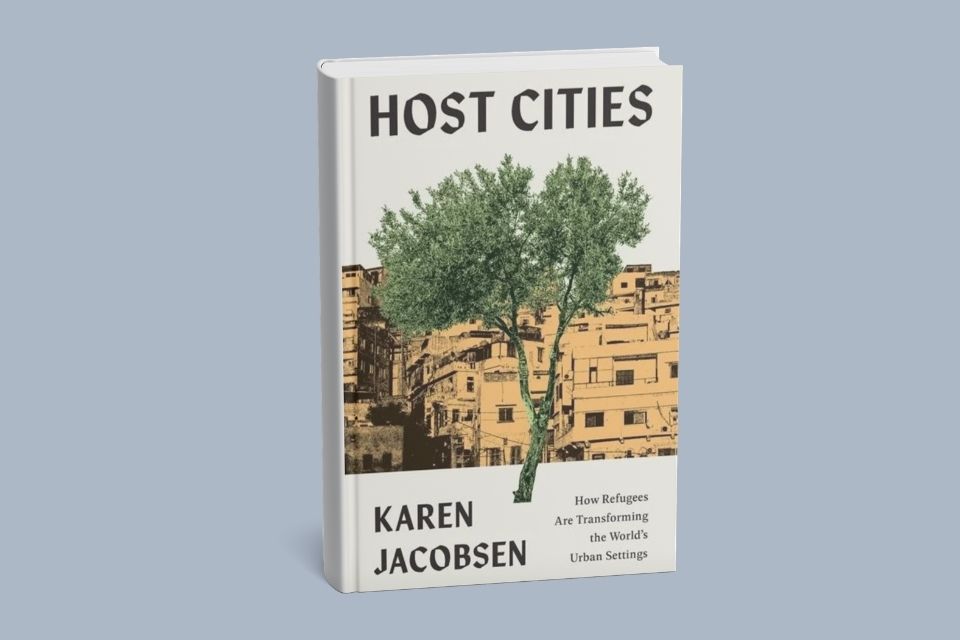
A revealing study of how the arrival of refugees affects and transforms cities
Cities all over the world experience large humanitarian influxes, and refugees and citizens alike must navigate the related risks and opportunities. Over the past twenty-five years, Karen Jacobsen has studied the interaction of refugees and cities and has trained scores of graduate students, many of whom now work with United Nations agencies or humanitarian nongovernmental organizations. Her research team at Tufts and this global network of aid workers give her firsthand knowledge of the impact of forced migration on cities and the lives of refugees living there.
The usual picture of displacement is a camp of tents and food queues. Karen Jacobsen’s Host Cities starts from the fact that many refugees leave camps like Dadaab or Zaatari for cities such as Cairo, Athens, Beirut, Dar es Salaam, or Nairobi, yet little research has examined how these arrivals shape their new cities and are shaped by them.
Focusing on cities and refugees in Africa and the Middle East, Jacobsen draws universal lessons, distilling her research findings and wisdom from decades of experience into clear, vivid prose.
Rather than surveying everything, she builds the book mainly around two case studies: Cairo, a megalopolis, and Tripoli, Lebanon, a “second city”. Her key concept is the “humanitarian influx,” which she defines as more than 10,000 refugees arriving in a city within a short period, a pattern she argues differs from the slower migration of other newcomers. As refugees arrive into existing historical, political and urban conditions, they add a new layer to the city, bringing real pressures such as more garbage, rising rents, food scarcity, and crowded schools.
The book is at its best when it moves from problems to contributions. Refugees often show considerable ingenuity, especially where formal work is barred. Jacobsen’s examples include a Syrian-founded fast-food chain in Cairo that is popular with Syrians and Egyptians alike, and a Sudanese man arranging health tourism for people unable to get care at home. She argues this entrepreneurship strengthens local economies and links them to transnational networks.
Jacobsen then continues with the policy suggesting that funders, aid agencies, governments, and communities should rethink their practices so that refugees and locals alike benefit. She favors the shift from food distribution to cash assistance, which gives refugees more control over their spending and sends money to local vendors. She also argues that aid aimed only at refugees can breed resentment in already poor host communities.
With the rising numbers of people forcibly displaced around the world, Host Cities offers useful frameworks for treating refugees as potential assets to well-supported host cities, not only as a responsibility. The book is valuable for researchers, policy analysts, donors, and humanitarian workers in cities around the globe and for all readers trying to understand, beyond the headlines, one of the most troubling and volatile issues of our time.